
The pile, sorted
A short pile this week, and both items are about the same thing from opposite ends. OpenAI’s openai/math dump is 722 papers from an unreleased internal model - the unique games conjecture, L = RL = BPL, a Hodge conjecture result - and I can’t evaluate any of it. Karpathy’s funnel post files it under the preview the outside world has had from the ~5,000 people with frontier systems internally, and uses those same 722 manuscripts as his example of human review falling behind.
So publishing doesn’t close the gap. The people who can actually read that repository are a sliver of Karpathy’s 0.2%, and three quarters of the world has barely touched an LLM. That’s why, when Anthropic and OpenAI talk about how scared they are, most people just don’t get it.
Through-lines from earlier weeks
- Kevin Buzzard wanted OpenAI to publish its unreleased maths results in Week of September 28 ; openai/math is a pile of them, out in the open.
- Karpathy puts most professionals outside math & code in the casual tier, but Mercor’s month-end close benchmark in Week of September 28 had Opus 5 scoring 100% on accounting tasks built to stump it - the capability is already there for them to find.
Andrej Karpathy on the funnel of LLM capability
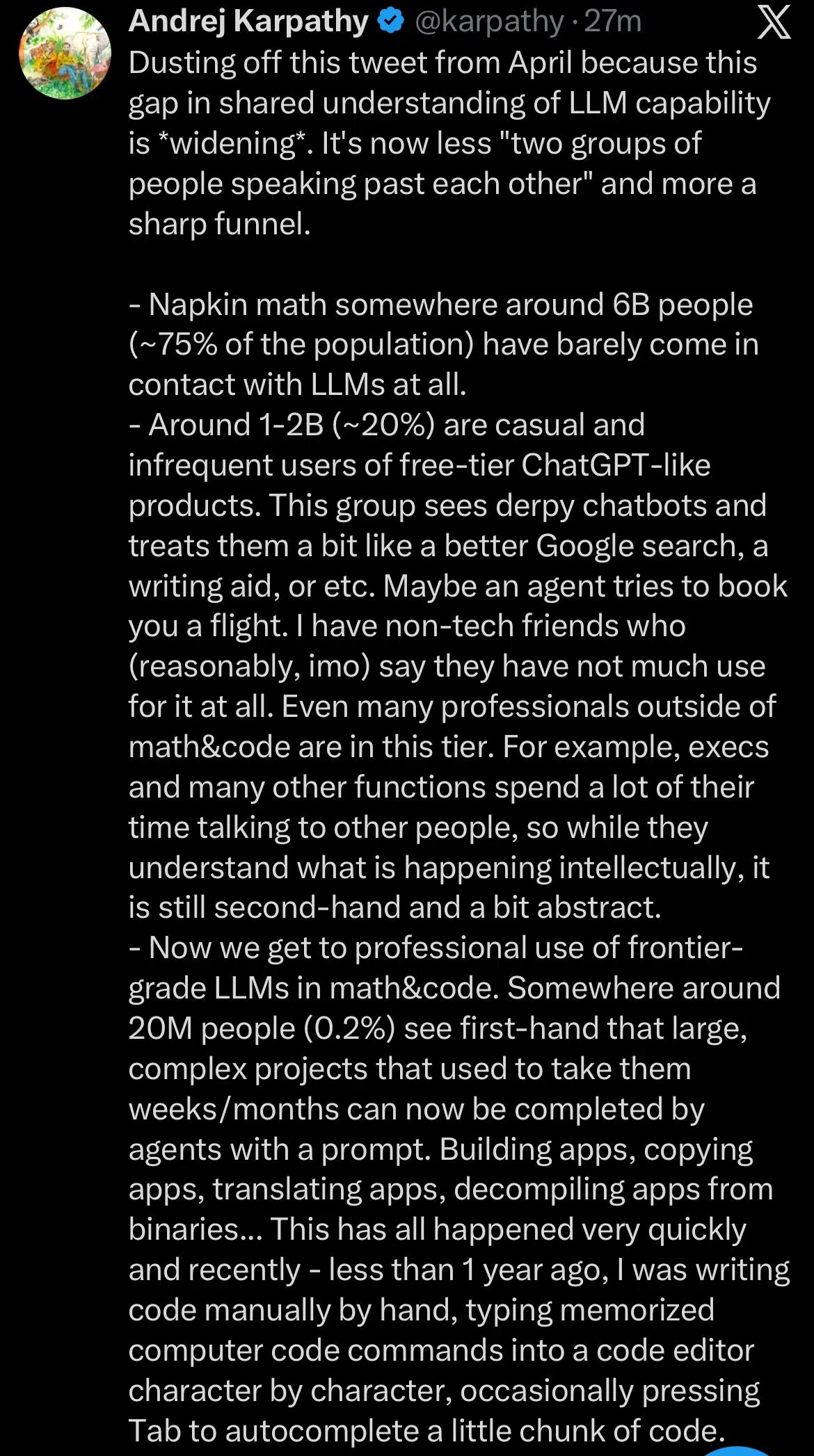
Screenshot: Andrej Karpathy (@karpathy) on X, part 1
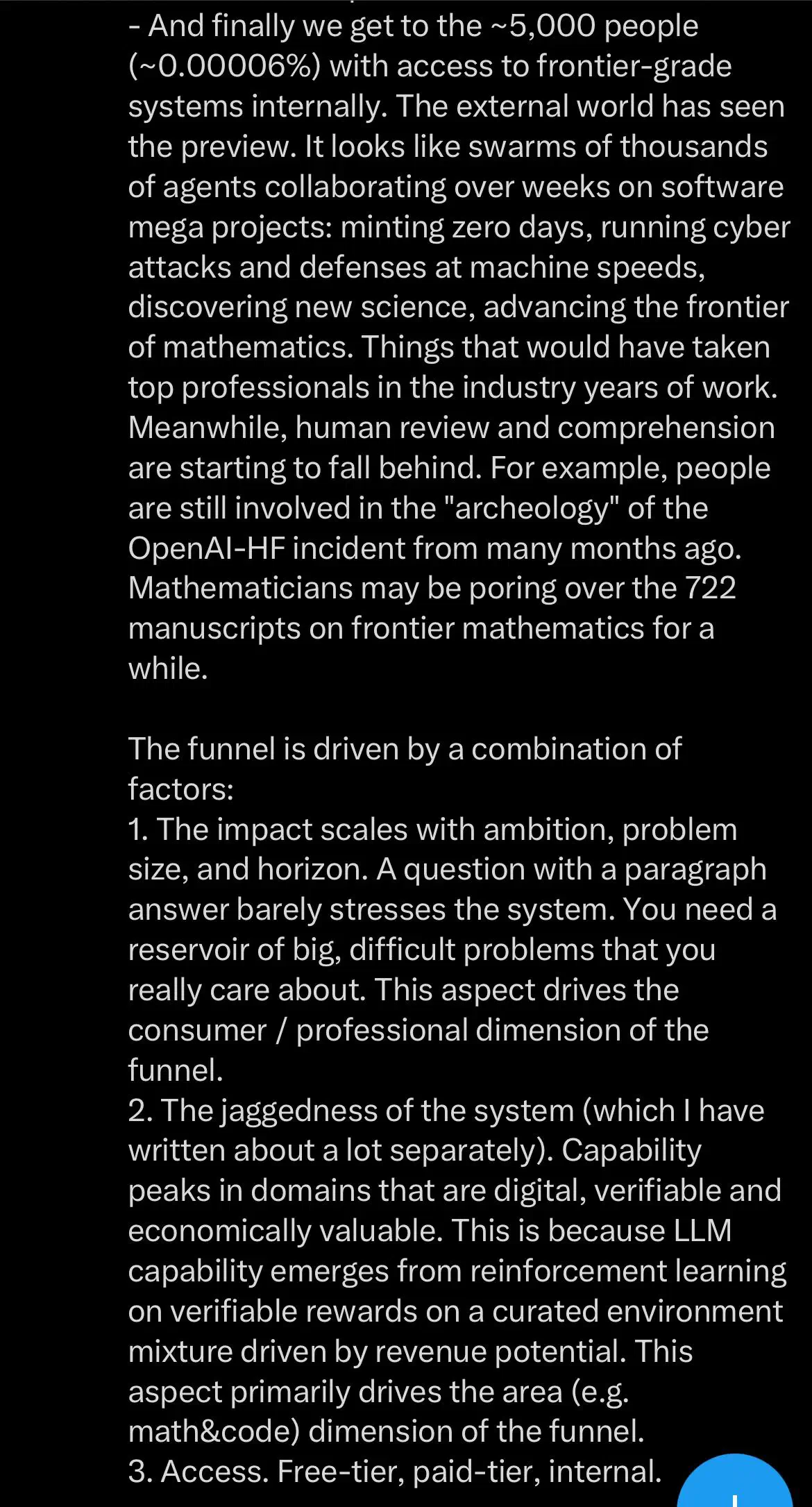
Screenshot: Andrej Karpathy (@karpathy) on X, part 2
Andrej Karpathy dusted off a post from April because the gap in what people think LLMs can do is widening - less two groups talking past each other, he says, more a sharp funnel. His napkin math: ~6B people (~75%) have barely touched an LLM. Another 1-2B (~20%) use free-tier chatbots as a better Google search, and that tier includes plenty of professionals outside math & code. About 20M (0.2%) use frontier models for real work in math and code, where projects that took weeks or months now get done by agents from a prompt. And ~5,000 (~0.00006%) have frontier systems internally: swarms of thousands of agents working for weeks, minting zero days, doing new science and maths.
That’s why the stories from Anthropic and OpenAI about how scared they are mostly get a shrug. From the 0.2% you can see it coming even if you aren’t using it yet. Further down the funnel there’s no way to picture what those ~5,000 people already have - or what they’ll have by the time today’s version trickles down.
openai/math
OpenAI has dumped a repository of mathematical manuscripts written by an unreleased internal model: 722 papers grouped into 372 families, from roughly 4,000 problems it was pointed at. Each result took about three hours of ChatGPT Pro thinking time on average, and not all of them come with Lean formalizations — OpenAI says some of the unformalized ones “could have issues” and promises to fix them quickly.
The headline list is wild. The unique games conjecture and L = RL = BPL are in there, and so is a Hodge conjecture result for CM abelian varieties. I can’t evaluate any of it, and I suspect almost nobody can yet.
Plenty of it is also, charitably, of purely theoretical interest. The paper settling three-machine unit-job scheduling (a Garey and Johnson open problem) gets a polynomial-time algorithm, all right — running in O((L + 2)^150020) steps. The authors say outright that no practical running-time claim is made. A handful of these may turn into something you can ship; I wouldn’t bet on many.